
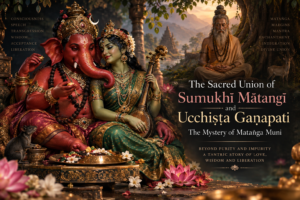
The Sacred Union of Sumukhī Mātangī and Ucchiṣṭa Gaṇapati
The Marriage of Mataṅgī and the Lord Beyond Convention
Among the esoteric traditions of Tantra, the relationship between Sumukhī Mātangī and Ucchiṣṭa Gaṇapati is especially fascinating. Their union represents the meeting of Śakti and consciousness, speech and mantra, wisdom and unconventional spiritual power.
Mātangī is one of the Daśa Mahāvidyās, the Ten Great Wisdom Goddesses. She is associated with speech, music, mantra, forbidden knowledge and the transformation of what society rejects. As the daughter of Mataṅga Muni, she came to be known as Mātangī.
Ucchiṣṭa Gaṇapati is a powerful Tantric form of Lord Gaṇapati, associated with the transcendence of conventional ideas of purity and impurity. In certain Tantric and oral traditions, Sumukhī Mātangī is regarded as his consort.
The Story of Their Marriage
When Mātangī blossomed into womanhood, Mataṅga Muni wished to arrange her marriage with a perfect gentleman. However, no Vedic Brahmin was willing to marry her, nor would the Vedic-influenced Kshatriyas accept her. She was dark in complexion, and in that social context, dark colour was associated with communities outside the Vedic order.
Mātangī therefore turned to spiritual practice. Desiring a worthy husband, she undertook sādhana of Lord Gaṇapati.
Seeing her determination, Mataṅga Muni initiated her into the thirty-two-letter Mahāmantra of Ucchiṣṭa Gaṇapati. Father and daughter then performed intense sādhana together at Mataṅga’s āśrama.
Pleased with their devotion, Lord Ucchiṣṭa Gaṇapati appeared from the yajñakuṇḍa of Mataṅgāśrama. He appeared completely naked, red in colour and with the head of an elephant.
This extraordinary form deeply impressed Mātangī. Rather than being disturbed by his unconventional appearance, she recognised his divine power and proposed marriage to him.
Lord Ucchiṣṭa Gaṇapati accepted her proposal, and their marriage was celebrated in the month of Chaitra, on Śukla Ṣaṣṭhī.
Thus, Mātangī became the beloved Śakti of Ucchiṣṭa Gaṇapati.
The Tantric Meaning of Their Union
Their marriage is more than a mythological account. It expresses a central Tantric teaching: the Divine is not limited by social approval, external appearance or conventional ideas of purity.
Mātangī represents the power of speech, music, mantra and wisdom arising from the margins. Ucchiṣṭa Gaṇapati represents consciousness that moves beyond rigid divisions such as pure and impure, sacred and profane, accepted and rejected.
Together, they symbolise:
- consciousness and Śakti
- mantra and speech
- intelligence and expression
- awareness and enchantment
- the remover of obstacles and the power that transforms them
Their union teaches that what society rejects may still contain profound spiritual power. Mātangī’s dark complexion and Ucchiṣṭa Gaṇapati’s unconventional form challenge superficial judgments and reveal that Divine reality cannot be confined to social standards.
The Blessing of Mātangī and Ucchiṣṭa Gaṇapati
Mātangī reminds the sādhaka that speech is Śakti. Words, music and mantra can bind, transform or liberate. Ucchiṣṭa Gaṇapati teaches that spiritual awakening requires moving beyond unconscious conditioning and rigid divisions.
Their sacred marriage therefore represents the integration of the rejected, the unconventional and the Divine.
Mātangī is the voice of hidden wisdom.
Ucchiṣṭa Gaṇapati is the consciousness that embraces what others reject.
Together, they reveal that the path to wholeness does not always begin with rejection. Sometimes it begins by recognising the sacred power within what we have been taught not to see.
A Note on Tradition
The story of Mātangī, Mataṅga Muni and Ucchiṣṭa Gaṇapati belongs to Tantric and oral traditions, and variations may exist across different lineages. The account presented here reflects an esoteric tradition in which Mātangī receives initiation into the thirty-two-letter Mahāmantra of Ucchiṣṭa Gaṇapati, performs penance with her father and ultimately marries the Lord after his manifestation from the yajñakuṇḍa.
Discover more from Dr Pallavi Kwatra
Subscribe to get the latest posts sent to your email.