

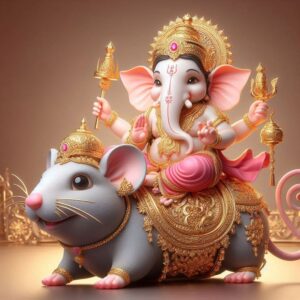
IMAGE CREDITS: https://in.pinterest.com/pin/129548926778703973/
Visit the most unique website on Ucchista Ganapati at Ucchistaganapati.in
( For blogs, videos, sadhana initiations, Pujas, Books, Yantras and Idols of Ucchista Ganapti all at one place)
The Ucchista Ganapati Ashtottara Shatanamavali, commonly known as the Ucchista Ganapati Ashtottaram, is a devotional hymn comprising 108 names that extol the various attributes and virtues of Ucchista Ganapati.
oṃ mūṣakāṅkamahāraktaketanāya namo namaḥ oṃ
ॐ मूषकाङ्कमहारक्तकेतनाय नमो नमः ॐ
Salutations to the One whose banner/flag is red in color and adorned by his favorite vehicle, the rat – mūṣakāsurā.
Verse 61: The Red Banner and the Rat
Sanskrit:
ॐ मूषकाङ्कमहारक्तकेतनाय नमो नमः ॐ
Transliteration:
oṃ mūṣakāṅka–mahārakta–ketanāya namo namaḥ oṃ
Word-by-Word Translation
-
oṃ — primordial sound, essence of creation, sacred seal.
-
mūṣaka–aṅka — “bearing the rat (mūṣika) as a mark/insignia”; the rat here is Gaṇeśa’s chosen vāhana, originally Mūṣikāsura, the asura subdued and transformed into service.
-
mahā–rakta — “great red”; referring to the blazing red color, the hue of vitality, passion, auspiciousness, and śakti.
-
ketanāya — “to the one whose banner/flag is [of this nature]”; a symbolic standard of victory, presence, and divine identity.
-
namo namaḥ — repeated prostrations, expressing surrender and devotion.
-
oṃ — closure, sanctifying the mantra in wholeness.
Detailed Commentary
This verse highlights two defining emblems of Ucchiṣṭa Gaṇapati: the rat insignia and the red banner.
-
The Rat as Insignia (Mūṣakāṅka)
-
Beyond being a vāhana, the rat is described here as Gaṇeśa’s aṅka — an inseparable mark of his presence.
-
The rat, once a demon (Mūṣikāsura), became a symbol of arrogance humbled and transformed into service. Gaṇeśa does not destroy blindly; he redeems, redirects, and reintegrates energies for divine work.
-
As insignia, it teaches sādhakas that even the basest tendencies can be transmuted into spiritual vehicles under Gaṇapati’s grace.
-
-
The Red Banner (Mahārakta Ketanāya)
-
The banner, or ketana, represents victory, dominion, and divine proclamation.
-
Its color — mahārakta (deep red) — is not accidental. Red is the color of śakti, kāma (desire), and rajas (dynamic activity). It announces Gaṇapati as a deity of fertility, vitality, and tantric fire.
-
In the tantric stream, red also signifies ucchiṣṭa energy — raw, leftover, outside convention, yet potent in transformation. Thus, the banner is a declaration that Gaṇapati reigns in both the sacred and the taboo.
-
Spiritual Significance
-
The Rat + The Banner = a complete vision of transformation and triumph:
-
The rat shows that even what is rejected, base, or cunning can be consecrated into divine service.
-
The red banner shows that Gaṇapati does not hide his power; he openly declares victory through śakti.
-
-
For practitioners, the verse is a reminder that:
-
No tendency within us is too small or too impure to be transmuted.
-
Flying the “red banner” inwardly means owning one’s desire, passion, and power, while consecrating them at the feet of Gaṇapati.
-
-
In worship, meditating on this form strengthens the ability to redirect passions and to proudly fly the banner of victory over inner demons.